
Reaction Game for Al Salam Bank
We designed and developed an interactive reaction game for Al Salam Bank, combining digital gameplay with physical interaction to create an engaging on-ground experience. The game challenges participants to react quickly as blinking lights activate in sequence, requiring precise and timely button presses within a one-minute countdown. A dedicated screen displays the live score and remaining time, adding excitement and competitiveness. Built using Unity, integrated with custom electronic circuits and physical interaction elements, the installation successfully attracted crowds, increased engagement, and delivered a memorable brand experience.
Sixty seconds, a wall of lights, and a queue that formed by itself
Joby Thuruthel / FAIM · Updated 31 October 2026 · 12 minute read
Every stand game is designed for one moment. Someone is walking past with somewhere else to be. A light blinks, a stranger slaps a button, a number on a screen jumps, and the person walking past slows down. Then they stop. Then they are standing in a line they did not plan to join.
That moment is the whole brief. Everything else we built for Al Salam Bank, the Unity game, the custom circuit boards, the round buttons on the curved wall, the score screen and the leaderboard, exists to make that slowdown happen again and again, all day, without anyone having to explain the rules.
A good event activation does not ask for attention. It earns it in the time it takes to walk past, then turns a passer-by into a player, and a player into a name the brand can follow up.
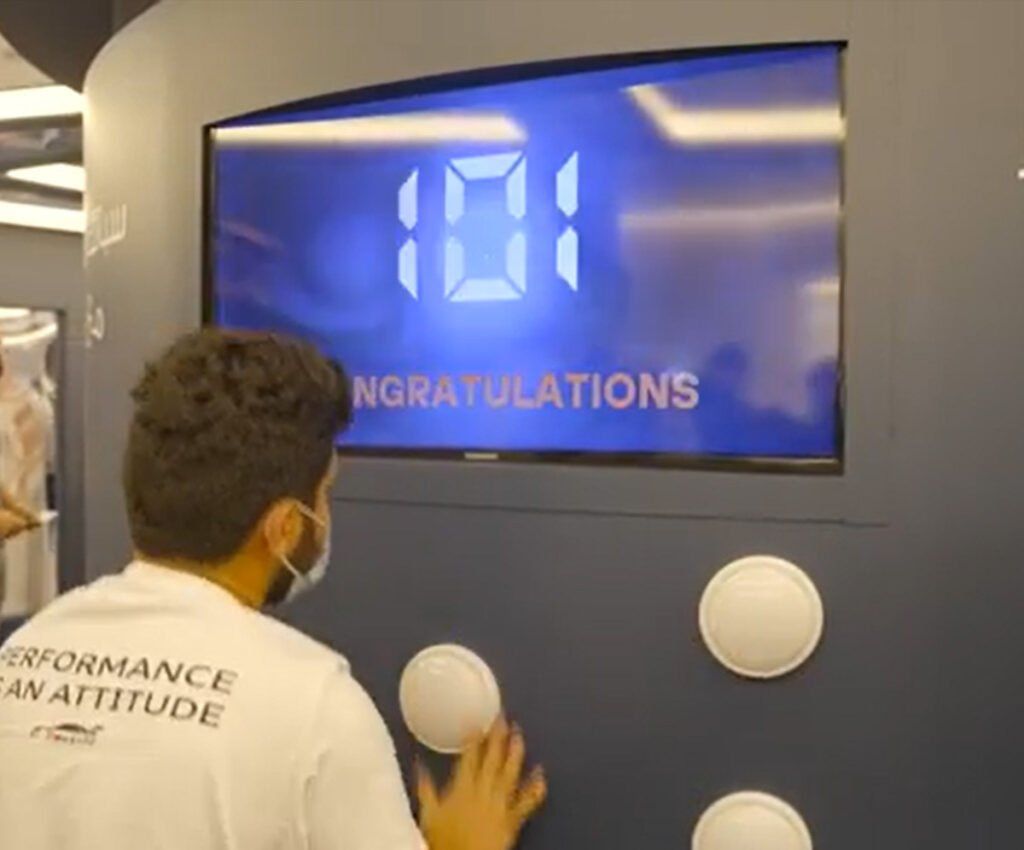
The reaction game for Al Salam Bank. Round light buttons on a branded wall, a one-minute clock, and a dedicated score screen. This player finished on 101.
The brief behind the game
Banks have a particular problem at events. What they sell is trust, service and products you cannot pick up and hold. A stand can show a logo, a rate and a smiling photo, and none of it gives a visitor a reason to stop. The usual answer is a giveaway, and the usual result is a queue of people who want the giveaway, not the brand.
The request was the opposite of that: an on-ground experience that people would choose to play, that would draw a crowd on its own, and that would leave the bank's name in their heads after they walked away. The reaction game was the answer, a format that mixes digital gameplay with physical interaction so the whole body is involved, not just a thumb on a tablet.
The mechanic is simple on purpose. Lights blink in sequence across the buttons. The player hits each one as it lights. A countdown runs from one minute. The score and the time left sit on a screen big enough to read from the aisle. Anyone understands it after watching one round, which matters, because the people watching are the next players.
Seven problems we had to solve
A game like this looks easy from the outside. Most of the work is in the parts nobody notices when they are done well. These are the problems we worked through, and what we did about each one.
Problem 01 · Being seen
A tablet quiz on a counter is invisible from three metres away. If the game cannot be seen from the aisle, it never gets its first player.
What we did
Large lit buttons on a tall branded wall, sound on every hit, and a score screen at head height. The game advertises itself while someone else is playing it.
Problem 02 · Keeping the line moving
A long game means a long queue, and a long queue means people give up and walk off.
What we did
A fixed one-minute round and a reset of a few seconds. At peak, one station handles well over a hundred plays an hour, and the next player is ready before the current one finishes.
Problem 03 · A fair clock
In a reaction game, the score is the game. If the computer is busy for a moment, a player's press can be read late and their score drops for no reason.
What we did
Press time is read on our own circuit board at the moment of the press, not inside the game engine. A busy frame in Unity never changes a score.
Problem 04 · Hardware that survives a crowd
Event hardware gets hit, leaned on and played by children, for hours, in front of a client who is watching.
What we did
Arcade-grade buttons, targets mounted so a miss does not bend anything, wiring in a loom that can be swapped on site, spare boards and buttons at every show, and a FAIM technician on the floor.
Problem 05 · Difficulty
Too easy and the score means nothing. Too hard and people stop after one try.
What we did
We playtest sequence speed and target spacing until a first-time player lands somewhere in the middle and a second try visibly improves. That improvement is what brings people back, and a second play is a second minute with the brand.
Problem 06 · The brand inside the play
A rented arcade machine with a logo sticker does not carry a message. People remember the game and forget whose it was.
What we did
The targets, the countdown screen, the sounds and the celebration state all carry the client's identity, and the messages between rounds are the ones the client wants remembered.
Problem 07 · Knowing who played
A game can run all day and leave the client with no idea who played or how to reach them.
What we did
Every play writes a record: score, time, and an optional name and contact with consent at the end. The leaderboard and the prize draw run from those records, on the game's own local network.
Watch a round, from QR code to leaderboard
This is the loop every player goes through, rebuilt as a small live demo and sped up so a full minute fits into a few seconds. A visitor scans the code and types a name, the lights start, every hit adds to the score, and when the clock runs out their name lands on the board in the right place. If they beat the top score, the whole board knows about it.
Live demo · sped up
0 · TIME 60s
Scan to join
Leaderboard · today · Hits
Illustration with sample names and scores, not data from the event. On a real board, only players who chose to enter a name appear.
How the leaderboard works
The leaderboard is the part people underestimate. A score on its own is a private moment. A score with a name next to it, on a screen everyone can see, is a public challenge, and a public challenge is the strongest invitation to play again. Friends push each other back into the line. A name at the top of the board can pull people over from the next stand.
Behind the screen, it works like this.
- Joining. A player scans a QR code and types a name on their own phone, so nobody on the stand has to type anything, or a host enters it at the start. No app and no login.
- Scoring. Every hit is counted on the circuit board and sent to the game over a serial link. The final score is written with the time of the play.
- Ranking. The board updates the moment a round ends. It can reset every session, every day or run across the whole show, depending on how the prizes work.
- Celebrating. A new top score triggers its own state on the screen, branded for the client, so the crowd knows something happened.
- Capturing. Contact details are asked for after the fun, never before it, with a clear consent box. A player who wants their prize is happy to give their details.
- Closing. At the end of each day the prize draw runs from the records automatically, and the client gets the export: names, scores and consented contacts.
The same scoring backbone sits under our VR safety training for Tasnee, where decision accuracy and reaction time are logged for more than 200 participants. A competitive stand game and a training module are closer than they look.
The signal path, from a hand to a lead list
Every FAIM system has the same four parts: what the visitor touches, the application that runs it, what comes out, and the panel the client's team controls. Here is that path for the reaction game.
Unity tells the board which button to light. The board tells Unity which button was pressed and exactly when. Everything after that runs on the game's own network.
What we measure, and why
We do not publish numbers we did not measure, and we will not invent them for a case study. What we can show is the framework every FAIM game logs, so a client can judge an activation on evidence instead of a feeling.
100+ / hr
Plays one station can handle at peak, with one-minute rounds and a reset of a few seconds.
FAIM stated capacity
Repeat rate
How many players come back for a second round. The clearest sign that the difficulty is right.
Logged per event
Opt-in rate
How many players leave a name and contact with consent at the end of a play.
Logged per event
Peak hours
When the line was longest, so the client knows when to put their best people on the stand.
Logged per event
Five moments every player goes through
- Noticing Lights, sound and a climbing score pull the eye from the aisle. The queue is part of the show.
- Joining A QR code or a quick name at the start. No app, no login, no staff member typing at a keyboard.
- Playing Sixty seconds, all in. Hit the lights, beat the clock. Rules anyone understands in one look.
- Ranking The score lands, the name appears on the board, and a new top score gets its own celebration.
- Following up Consented contacts and scores exported at close, a prize draw picked from the records, and a list the client's team can actually call.
How FAIM delivers a game like this
The same people design the experience, build the software and the content, specify and build the hardware, and stay on site while it runs. Nothing is handed between agencies, so nothing gets lost between them. This is the process we follow on every games project.
- Message first We start with what a player should remember, then design a mechanic that makes them repeat it.
- Mechanic and arena Reaction, motion, strength, knowledge or hunt. The physical form is designed with the mechanic.
- Build Unity game, custom electronics and controls, scoring rules, leaderboard and capture flow, in Arabic and English.
- Playtest Tested for difficulty, duration and queue flow, so one play takes about a minute and the line moves.
- Install Arena built, sensors calibrated, sound and lights set for the venue, run through before doors.
- Run and report Technician on the floor. Leaderboard, prize draw and lead export at close.
Timelines. Adapting one of our existing games with your branding, messages and prizes takes 5 to 10 working days from approval and advance. Two or three connected games feeding one leaderboard take about 4 to 6 weeks. A new mechanic with custom hardware usually takes 4 to 6 weeks as well. The client owns the delivered assets, and FAIM keeps its own underlying tools and reusable systems, which is exactly why the next build is faster.
Event activation in Bahrain: what changes on the ground
We are a Bahrain studio, and most of what we build is used in Bahrain and Saudi Arabia. A few things come up on almost every activation here.
Two languages
Arabic and English on every screen, every instruction and every message between rounds, as standard, not as an extra.
Venue Wi-Fi
Halls fill up and networks slow down exactly when the crowd arrives. Our games run on their own local network, with content on the devices.
Outdoor sites
National Day, mall forecourts and open-air events change the brief. The screen has to fight daylight, the buttons have to survive heat and dust, and power and cable runs are planned for an open site from the first sketch.
Mixed crowds
Families, students, executives and children play the same game in the same hour. The mechanic has to be fair to all of them and safe for the smallest.
One of our recent reaction game enquiries came from an event organiser in Bahrain who wanted big physical buttons, a live leaderboard, QR sign-up and an outdoor LED screen. How that brief reached us is a story of its own: ChatGPT found us, a friend sent the client.
Other event gamification formats we build
The reaction wall is one format. The same scoring, leaderboard and capture layer sits under every game in our catalogue, so a stand can mix them and keep one board and one lead list. These are the ones clients ask about most.
Reaction and strength
GLADIATOR light-strike arena, TITAN boxing-pad challenge and the VALIANT goal wall.
Motion and floor
REFLEX gesture game with no touch (try the demo) and the MERIDIAN pressure-reactive LED floor.
Phone-to-screen
PULSE live votes and battles and the VOYAGE QR scavenger hunt, played on the guest's own phone.
Themed challenges
BLADE fast brand challenges and CITADEL cybersecurity games that teach through competition.
See all of them on our event gamification in Bahrain page, or open the full product catalogue.
Questions clients ask
What is event gamification?
Event gamification turns guests into players. A short game with a live score, a leaderboard and a prize gives people a reason to stop, a reason to queue and a reason to remember the brand. FAIM builds reaction walls, motion games, interactive floors and QR phone games for event activations in Bahrain and Saudi Arabia.
How did the Al Salam Bank reaction game work?
Lights blinked in sequence across round buttons on a branded wall. The player pressed each one as it lit, against a one-minute countdown, while a dedicated screen showed the live score and the time left. It was built in Unity with custom electronic circuits and physical controls.
How many people can play a reaction game in a day?
With one-minute plays and a reset of a few seconds, one station handles well over a hundred plays an hour at peak. For bigger crowds we add stations that feed the same leaderboard.
How long does it take to build a reaction game for an event in Bahrain?
Adapting one of our existing games with your branding, messages and prizes takes 5 to 10 working days from approval and advance. A new mechanic with custom hardware usually takes 4 to 6 weeks.
Can players join with a QR code and see their name on the leaderboard?
Yes. A player scans a QR code, enters a name on their own phone and sees it on the board when the round ends. Contact details are asked for after the play, with a consent box, never before it.
Does the game need venue Wi-Fi or internet?
No. Scoring, the leaderboard and lead capture run on the game's own local network. The export at close is yours.
Can a reaction game run outdoors?
Yes, if it is planned for outdoors from the first sketch. The screen has to fight daylight, the buttons and enclosure have to handle heat and dust, and power and cable runs are planned for an open site.
What happens if a button breaks during the event?
A FAIM technician on the floor swaps it from spares in minutes. The electronics are modular for exactly this reason, and we carry spare boards and buttons to every show.